




When designing an aluminum heat sink for a compact electronic assembly, selecting the mounting method is just as important as choosing the fin profile. The heat sink must maintain reliable thermal contact with the component while remaining mechanically secure throughout the equipment's operating life.
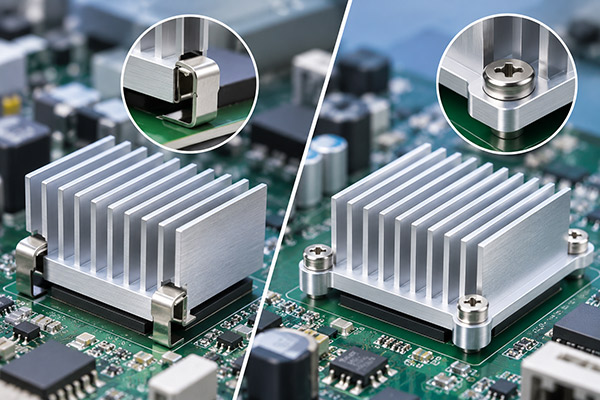
Two commonly considered approaches are clip-on mounting and screw-based mounting. Each has advantages and limitations involving installation space, retention force, assembly speed and mechanical loading.
Why Does Heat Sink Mounting Affect Cooling?
Heat must pass from the electronic component into the heat sink base before it can be released through the cooling fins.
Microscopic gaps between the mating surfaces increase thermal contact resistance.
A suitable thermal interface material can help fill these gaps, while the mounting system maintains the contact conditions required by the component and interface material.
If the heat sink becomes loose or the contact force changes significantly, component temperatures may rise.
How Does Clip-On Heat Sink Mounting Work?
Clip-on mounting uses a mechanical spring or retaining clip to secure the heat sink to a package, mounting frame or other approved attachment structure.
Depending on the design, the clip may connect to a retention bracket, frame or dedicated hardware.
Potential Advantages
May reduce the number of assembly operations.
Can be suitable for compact equipment.
May allow convenient replacement in serviceable designs.
Can provide controlled spring force when properly engineered.
Potential Limitations
The available retention force depends on the clip design and its supporting structure.
Incorrect spring geometry may create uneven loading or insufficient thermal contact.
The design must also account for vibration, handling loads and possible interference with surrounding components.
How Does Screw-Mounted Cooling Work?
Screw-mounted heat sinks use threaded fasteners to secure the cooling assembly to a suitable mounting structure.
Some designs incorporate springs or other load-control features to manage the pressure applied to electronic components.
This approach can provide flexible mounting arrangements, particularly for larger or heavier aluminum heatsinks.
However, screw tightening procedures and the supporting mechanical structure must be carefully specified.
Clip-On vs Screw Mounting Comparison
| Design Factor | Clip-On Mounting | Screw Mounting |
|---|---|---|
| Assembly | May require fewer steps | Requires fastening operations |
| Contact force | Depends on spring and retention geometry | Depends on fasteners, springs and joint design |
| Serviceability | Depends on clip accessibility | Depends on screw accessibility |
| Supporting structure | Needs suitable clip retention points | Needs suitable threaded or through-hole mounting |
| Mechanical loading | Must be checked for bending and retention | Must be checked for preload and supporting structure |
| Best choice | Application dependent | Application dependent |
What Should Engineers Consider for CPU Heatsinks?
A CPU heatsink must meet processor-specific mechanical and thermal requirements.
These may include allowable mounting force, processor package dimensions, required contact area and restrictions on board deflection.
For compact industrial computers, the cooling assembly may also need to withstand equipment vibration and repeated service operations.
The CPU manufacturer's mounting instructions should take priority over generic heat sink fastening practices.
PCB Loading and Clearance Requirements
Mounting hardware can transfer forces into the printed circuit board or surrounding enclosure.
Excessive loading may cause board deflection, connector misalignment or damage to sensitive components.
Before approving the mounting arrangement, engineers should check:
Available mounting holes and keep-out zones.
Clearance to surrounding electrical components.
Heat sink and fastener mass.
Contact force distribution.
Vibration and shock requirements.
Accessibility for installation and maintenance.
What About Thermal Adhesives?
Thermal adhesives or tapes may be considered for certain lightweight components when suitable mechanical and thermal performance can be demonstrated.
However, adhesive selection requires evaluation of bond strength, operating temperature, aging, surface preparation and potential service requirements.
Adhesive mounting should not automatically be substituted for a specified mechanical retention system.
Mounting Design Checklist for OEM Buyers
| Requirement | Information to Provide |
|---|---|
| Component | Package dimensions and mounting limitations |
| Heat load | Maximum thermal requirement |
| Mounting method | Clip, screws or alternative arrangement |
| Mechanical loads | Expected shock, vibration and handling conditions |
| Thermal interface | Specified material and contact requirements |
| PCB layout | Mounting positions and component clearances |
| Qualification | Thermal and mechanical acceptance criteria |
Custom Aluminum Heat Sink Manufacturing
KINGKA provides custom aluminum heat sink manufacturing for electronic and industrial cooling applications.
Available customization includes extruded fin profiles, CNC-machined mounting holes, base dimensions and application-specific mechanical features.
OEM customers should provide the heat source specifications, mounting layout, thermal targets and expected production volume to support a manufacturing review.
Develop a Custom-Mounted Aluminum Heatsink
Need a compact heat sink for a CPU, power module or industrial controller? Share your drawings and mounting requirements with KINGKA.
View Custom Extruded Aluminum HeatsinksFrequently Asked Questions
Are clip-on heat sinks better than screw-mounted heat sinks?
Neither method is universally better. Suitability depends on component requirements, retention force, installation space and environmental conditions.
Can clip-on mounting be used for a CPU heatsink?
Yes, where the processor package and retention design specifically support the chosen method.
Does tighter screw fastening always improve cooling?
No. Excessive force may damage components or supporting structures. The approved contact force must be maintained.
Can mounting holes be customized on an extruded heat sink?
Yes. Suitable holes and mounting features can often be produced through secondary machining based on an approved drawing.
