




A bonded fin heat sink and a Skived Fin Heat Sink can both provide relatively high fin density for industrial electronics. However, the way the fins connect to the base is fundamentally different.
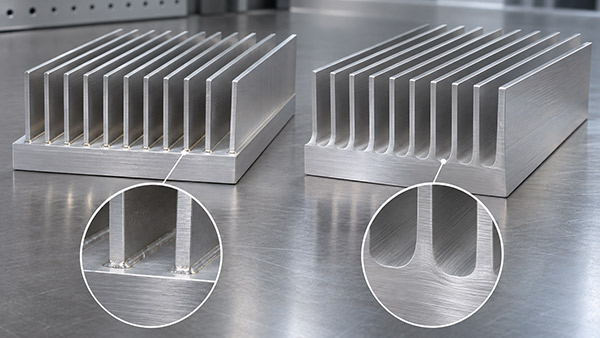
Bonded fin construction attaches separate fins to a base using a qualified joining method. Skived fin construction forms the fins directly from the base material. This distinction affects the thermal path, manufacturing process and inspection requirements.
How Does a Bonded Fin Heat Sink Work?
A bonded fin heat sink contains individual fins that are manufactured separately from the base.
The fins may be attached using a suitable thermally conductive adhesive or another joining process, depending on the product design.
The base distributes heat from the electronic component, while the attached fins transfer that heat into the surrounding air.
Bonded construction can provide flexibility in the choice of fin geometry and assembly structure.
However, the fin-to-base joint introduces a separate manufacturing interface that must be controlled.
How Is a skived fin heat sink Different?
A skived fin heat sink is produced by cutting and raising thin fins from a solid metal workpiece.
The fins and base remain one continuous piece of material.
As a result, there is no separate adhesive or brazed joint between the base and the skived fins.
This removes one potential interface from the conduction path.
However, the absence of a bonded joint does not automatically guarantee that every skived design has a lower total thermal resistance than every bonded fin design.
1. Understanding Fin-to-Base Thermal Resistance
Heat must travel from the base into the cooling fins.
In bonded fin construction, the thermal path includes the selected joint material and its contact regions.
The resistance of that joint depends on its thickness, conductivity, geometry and manufacturing consistency.
In a one-piece skived structure, heat travels through continuous parent metal between the base and fin.
Other factors, such as fin geometry, airflow and heat spreading, still influence the overall thermal performance.
2. Joint Quality and Manufacturing Control
Bonded fin assemblies require control of the joining process.
Depending on the method, important considerations can include bondline thickness, joint coverage, curing or joining conditions, and mechanical integrity.
Inconsistent joint quality may affect both heat conduction and mechanical reliability.
Skived fins avoid the separate joining step, but their own manufacturing concerns include fin formation, dimensional consistency and local deformation.
Neither technology should be selected without considering the relevant manufacturing controls.
3. Thermal Cycling and Reliability
Industrial electronics may experience repeated heating and cooling during operation.
Different materials in a bonded assembly can expand at different rates.
Depending on the joining system, repeated thermal movement may introduce mechanical stresses within the attachment region.
A skived fin design avoids the separate fin attachment interface but must still withstand thermal cycling, vibration and other service loads.
Reliability qualification should reflect the intended operating environment.
4. Fin Geometry and Manufacturing Flexibility
Bonded fin construction can allow separately produced fins to be combined with a selected base.
Skiving forms the fins from the original workpiece and is subject to the achievable fin thickness, height, width and material condition.
For some projects, bonded construction may provide a more practical geometry.
For others, the integrated structure of a skived heatsink may be attractive.
Bonded Fin vs Skived Fin Comparison
| Parameter | Bonded Fin Heat Sink | Skived Fin Heat Sink |
|---|---|---|
| Fin construction | Separately made fins | Fins formed from the base |
| Fin-to-base interface | Separate joining interface | Continuous parent metal |
| Manufacturing priority | Joint consistency and attachment quality | Fin geometry and skiving quality |
| Thermal resistance | Depends on joint and full design | Depends on full design without a separate joint |
| Mechanical qualification | Include attachment integrity | Include fin deformation and structural integrity |
| Design flexibility | Flexible fin assembly options | Limited by skiving process capability |
How Should OEM Buyers Compare Thermal Performance?
Both structures should be tested using representative heat loads, mounting interfaces and airflow conditions.
Important measurements can include the heat source temperature, base temperature and air inlet temperature.
If the bonded joint is a critical feature, suitable process qualification and reliability tests may also be required.
Thermal resistance figures from different suppliers should only be compared when their test conditions and temperature reference points are equivalent.
Custom Skived Fin Solutions from KINGKA
KINGKA offers custom skived fin heat sink solutions in aluminum and copper for applications requiring thin integral fins.
OEM engineers should provide the thermal load, installation limits, material requirements and expected airflow when considering a skived design.
Evaluate a Skived Fin Heat Sink for Your Project
Comparing different high-density heat sink structures? Review KINGKA's skived fin manufacturing options and submit your technical requirements.
View KINGKA Skived Fin Heat SinksFrequently Asked Questions
Is a bonded fin heat sink the same as a skived fin heat sink?
No. Bonded fins are attached separately to the base, while skived fins remain integral with the original metal.
Does a skived fin design eliminate contact resistance?
It eliminates the separate fin-to-base joining interface. The complete heat sink still has conduction and convection resistance.
Can bonded fin heat sinks provide high cooling performance?
Yes. Their performance depends on the quality of the fin-to-base connection, geometry and airflow conditions.
Which structure is better for OEM electronics?
The best choice depends on thermal requirements, dimensions, reliability expectations, manufacturing feasibility and cost.
