




For many OEM electronics projects, the quality of an aluminum heatsink must remain consistent across repeated production orders. Buyers need to know that supplied parts match the approved material, geometry and manufacturing specifications.
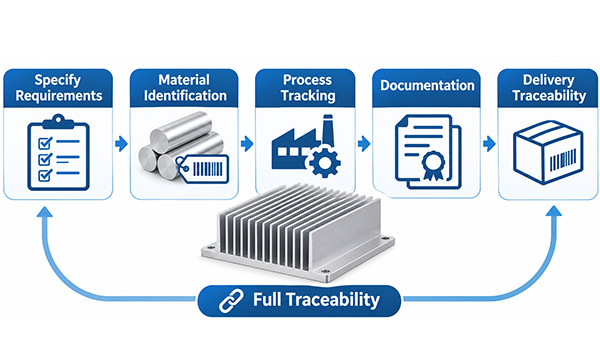
Material traceability provides a way to connect a finished component with the relevant manufacturing and inspection records.
When evaluating heat sink manufacturers, OEM procurement teams should define the level of traceability needed for the application rather than assuming every supplier uses the same documentation system.
What Is Material Traceability?
Material traceability is the ability to identify the origin and relevant processing history of a material or manufactured component through controlled records.
For an extruded aluminum heat sink, this may involve records for material supply, extrusion production, heat treatment, secondary machining and final inspection.
The required level of detail depends on product risk, customer requirements and applicable industry practices.
Why Does Traceability Matter for aluminum heatsinks?
Aluminum heat sinks are functional thermal components.
Material properties, dimensions and finishing conditions can influence their suitability for the final equipment.
If a nonconformance is discovered, useful production records can help identify which batches may require review.
Traceability also supports communication between purchasing, quality engineering and the manufacturing supplier.
1. Specify the Correct Alloy and Temper
Aluminum 6063 and 6061 are commonly used in extrusion applications, but they are not interchangeable in every design.
The manufacturing specification should identify the required alloy and temper where these characteristics are important.
Different tempers may have different mechanical properties and may be associated with different manufacturing conditions.
A drawing that states only "aluminum" may be insufficient for a controlled OEM application.
2. Define Material Documentation
Depending on the project, the buyer may request a material certificate, supplier declaration or other appropriate material records.
The required document should be specified before quotation and production.
Buyers should identify whether the documentation needs to include chemical composition, mechanical properties, material lot identification or other agreed information.
The existence of a certificate does not automatically prove that every finished part meets all dimensional and thermal requirements.
3. Connect Material Lots to Finished Parts
In a controlled production system, records can link an aluminum material lot or extrusion batch with a finished manufacturing batch.
When profiles are cut and machined, the identification process must account for the separation of material into smaller individual parts.
Not every heat sink requires a unique serial number. Batch-level identification may be appropriate for many applications.
The chosen method should reflect the required level of traceability and practical manufacturing constraints.
4. Record Important Manufacturing Changes
Significant changes to the approved design or manufacturing process may affect product performance.
Relevant records may include:
Approved drawing revisions.
Material alloy or supplier changes.
Extrusion tooling identification.
Specified heat-treatment conditions.
Critical machining process changes.
Surface finishing specifications.
Inspection acceptance and corrective action records.
Not every minor process adjustment needs customer approval, but the change notification requirements should be clearly agreed upon.
Recommended Traceability Documentation
| Document or Record | Purpose |
|---|---|
| Approved part drawing | Defines product dimensions and revision |
| Material specification | Identifies required alloy and temper |
| Material certificate | Provides agreed material information |
| Production batch record | Connects manufactured parts to a production lot |
| Inspection report | Documents specified quality checks |
| Coating record | Records surface treatment where required |
| Shipment identification | Supports receiving and batch identification |
Does Every Heat Sink Need Full Traceability?
No. Traceability requirements should match the application and consequences of failure.
A standard heat sink used in noncritical equipment may not require the same records as a component used in a tightly controlled industrial system.
Overly complex documentation can increase manufacturing and administrative costs without providing proportional value.
Buyers should determine which records are necessary and how long they need to be retained.
How to Evaluate Heat Sink Manufacturers
When selecting a supplier for recurring OEM orders, ask how the manufacturer identifies material batches and maintains manufacturing records.
Useful questions include:
How is the specified aluminum alloy verified?
How are production batches identified?
Can the supplied parts be linked to relevant inspection results?
How are material substitutions handled?
Which changes require buyer notification?
What documentation can be supplied with each shipment?
The supplier's answers should be confirmed against the intended project requirements.
OEM Aluminum Heat Sink Manufacturing with KINGKA
KINGKA provides OEM aluminum heat sink manufacturing solutions for industrial and electronic thermal management.
Available manufacturing options include aluminum extrusion, CNC machining and surface finishing according to customer drawings.
Buyers should submit their alloy requirements, inspection criteria, documentation needs and estimated quantities for review during the quotation stage.
Discuss Your OEM Heat Sink Requirements
Looking for a manufacturer of custom aluminum heatsinks? Share your engineering drawings, material specifications and quality documentation requirements with KINGKA.
Explore KINGKA Heat Sink ManufacturingFrequently Asked Questions
What information should an aluminum Heat Sink Material certificate contain?
The required information depends on the agreed specification. It may include alloy identification, chemical composition, mechanical properties and material lot references.
Is batch traceability different from serial number traceability?
Yes. Batch traceability identifies a group of parts associated with a production lot, while serial number traceability identifies individual units.
Can a material certificate replace dimensional inspection?
No. Material documentation and finished-part dimensional inspection serve different purposes.
Should traceability requirements be included in a heat sink RFQ?
Yes. Early specification helps the manufacturer evaluate documentation feasibility, cost and production requirements.
