

An aluminum FSW cold plate uses friction stir welding to join a metal cover to a machined base containing internal coolant channels. Because the coolant operates near valuable electronic components, the quality of the welded joint is a critical consideration for industrial applications.
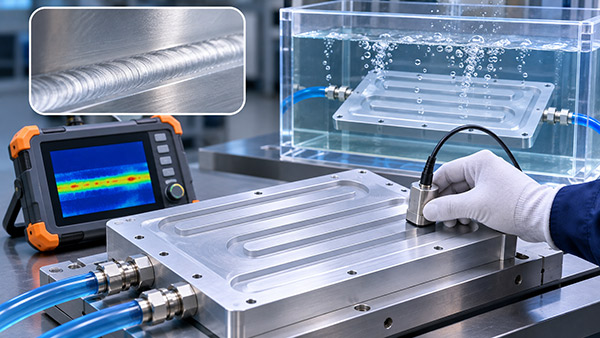
Friction stir welding is a solid-state process, but that does not mean every completed weld is automatically free from defects. Process conditions, joint preparation, material properties, and tool geometry can all influence weld integrity.
For buyers evaluating a friction stir welded cold plate manufacturer, it is important to understand which inspection methods verify the joint and which tests demonstrate the functionality of the completed plate.
Why Is Weld Quality Important?
The welded cover forms part of the pressure boundary that contains the circulating coolant.
A manufacturing defect may affect joint strength, fluid containment, or long-term reliability.
Potential welding concerns can include incomplete bonding, internal discontinuities, excessive thinning, or other process-dependent defects.
The relevant acceptance criteria depend on the plate construction, operating pressure, temperature, and specified service conditions.
1. Visual Inspection of the Weld Surface
Visual inspection is commonly used to examine accessible weld surfaces.
Inspectors may review the weld appearance, surface continuity, and visible indications of process irregularities.
However, a visually acceptable weld does not prove that the internal joint is free from defects.
Visual examination should therefore be treated as one part of the inspection plan.
2. Dimensional Inspection
FSW involves localized heating, plastic deformation, and mechanical loading.
Depending on the part geometry, these effects can influence the completed dimensions.
Relevant measurements may include:
Overall plate dimensions.
Mounting surface flatness.
Cover position.
Port and mounting-hole locations.
Specified weld-related geometry.
Critical clearances near internal passages.
Dimensional inspection is important because an acceptable seal does not guarantee correct mechanical fit or thermal contact.
3. Ultrasonic Inspection
Ultrasonic testing may be considered for selected FSW joints when the geometry and material permit a qualified examination method.
It uses acoustic waves to investigate internal conditions within the metal.
However, the ability to detect a defect depends on its location, orientation, size, and the inspection technique.
The presence of nearby coolant channels and complex plate geometry may complicate interpretation.
For this reason, ultrasonic testing should not be described as automatically detecting every weld defect.
4. Destructive Weld Qualification
During process development, representative weld samples may be examined using destructive methods.
These can include macrosection examination or mechanical testing selected according to the relevant joint requirements.
Macrosection examination can help evaluate the weld cross-section and identify selected internal features.
Destructive evaluation is generally performed on qualification samples rather than on every finished production plate.
The sampling plan and acceptance criteria should be established during process qualification.
5. Pressure Testing
Pressure testing evaluates the ability of the completed assembly to withstand an agreed test condition.
Hydrostatic or other suitable methods may be used, depending on the application.
The specified pressure, duration, and acceptance criteria should follow the design requirements and applicable procedures.
A passing pressure test is useful evidence of structural performance under the test conditions, but it does not demonstrate unlimited service life.
6. Leak Testing
Leak testing focuses on fluid or gas escape through the assembled pressure boundary.
Possible methods include pressure-decay testing and suitable gas-based leak detection methods.
The selected method should be sensitive enough for the application and compatible with the test article.
The customer and supplier should agree on the permitted leak rate, test medium, pressure, and acceptance procedure.
A statement such as "100% leak-free" is not a sufficiently precise engineering acceptance criterion without a defined test method and detection limit.
FSW Cold Plate Inspection Methods Compared
| Inspection Method | Primary Purpose | Important Limitation |
|---|---|---|
| Visual inspection | Check accessible surface condition | Cannot verify all internal features |
| Dimensional inspection | Check finished geometry | Does not verify internal weld integrity |
| Ultrasonic testing | Investigate selected internal indications | Requires qualified technique and access |
| Macrosection examination | Review weld cross-section | Destructive and sample-specific |
| Pressure testing | Assess pressure integrity at test conditions | Does not prove long-term fatigue life |
| Leak testing | Detect leakage above the method threshold | Depends on sensitivity and procedure |
Why Process Records Matter
When an FSW cold plate enters repeated OEM production, consistent manufacturing conditions become important.
Depending on the qualification plan, the manufacturer may control welding parameters, tooling condition, joint preparation, material identification, and inspection records.
Changes that could influence weld quality should be reviewed before implementation.
This helps ensure that the production process remains aligned with the approved design.
Choosing a Friction Stir Welded Cold Plate Manufacturer
OEM buyers should evaluate whether the supplier can provide appropriate manufacturing documentation, inspection methods, and test reports for the intended application.
KINGKA offers friction stir welded cold plate manufacturing using CNC machining, FSW processing, and application-specific quality verification.
Inspection requirements should be agreed during the RFQ and prototype development stages.
Source an Aluminum FSW Cold Plate
Need an aluminum FSW cold plate with clearly defined weld inspection, pressure testing, and leakage requirements? Send your drawings and quality specifications to KINGKA.
View KINGKA FSW Cold Plate ManufacturingFrequently Asked Questions
Does friction stir welding eliminate all weld defects?
No. FSW avoids some issues associated with melting-based welding, but its results still depend on a qualified process and suitable inspection.
Can a cold plate pass leak testing but fail another inspection?
Yes. A part may contain a dimensional or weld-related issue that does not produce detectable leakage during a particular test.
Is ultrasonic testing suitable for every FSW cold plate?
No. Its suitability depends on material, geometry, access, expected defect types, and method qualification.
Should pressure testing requirements appear in the OEM RFQ?
Yes. Buyers should define applicable test conditions and acceptance criteria before quotation and production approval.