




In compact electronic equipment, the housing and the cooling system compete for the same physical space.
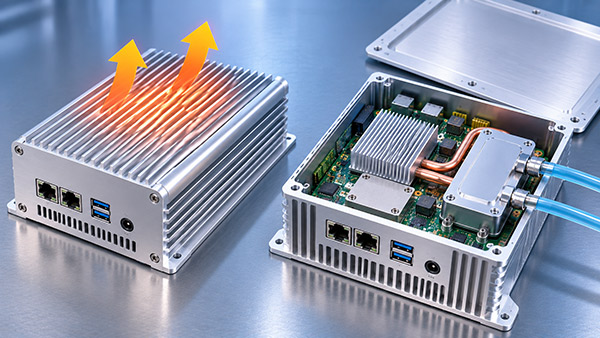
One option is to install a separate extruded aluminum heatsink inside or outside the enclosure. Another is to design the aluminum housing itself as part of the thermal management system.
Both approaches can be effective, but they create different requirements for mechanical design, heat transfer, assembly and service.
For OEM engineers, the decision should begin with the actual heat path and the role the enclosure must perform.
1. What Is an Integrated Heatsink Enclosure?
An integrated heatsink enclosure combines mechanical housing functions with a conductive path for removing heat.
For example, a power electronics housing may include external cooling fins formed as part of its aluminum extrusion profile.
Heat-generating components can transfer energy into the enclosure wall through a suitable mounting and thermal interface arrangement.
The enclosure then dissipates heat into the surrounding environment through convection and radiation.
However, the enclosure's effectiveness depends on its geometry, installation orientation and external operating conditions.
2. Advantages of Combining Housing and Cooling
An integrated aluminum enclosure may reduce the need for a separate heat sink component.
Potential benefits include:
Fewer individual metal components.
Reduced need for selected mounting brackets.
Potentially improved packaging efficiency.
Direct integration of structural and cooling features.
Opportunity to use external fins without occupying internal space.
These advantages are design-dependent. An integrated housing may also require more complex tooling, machining or surface finishing.
3. Why a Separate Heat Sink May Still Be Better
A separate heatsink provides flexibility to place cooling hardware close to the heat source without making the complete enclosure part of the thermal path.
It may also simplify replacement or redesign when electronic components change.
For example, a new power module may require a different mounting arrangement or thermal resistance.
If the heat sink is a separate component, the redesign may be limited to that part. If the fins are integral with the enclosure, changes to the cooling geometry may affect a larger structural component.
The practical result depends on the equipment design.
4. The Thermal Contact Path Is Critical
An integrated enclosure only functions effectively as a heat sink if heat can reach the relevant metal surfaces.
In some equipment, an electronic module may be separated from the enclosure by internal brackets, air gaps or materials with relatively high thermal resistance.
Under those conditions, adding external fins to the enclosure may provide limited benefit unless the internal heat transfer path is improved.
Engineers should define:
Which component generates the heat.
How that component connects thermally to the enclosure.
Which surfaces distribute the heat.
How heat reaches the external air.
What maximum temperatures are permitted.
The design should be evaluated as a complete thermal system.
5. Does an Extruded Housing Offer Manufacturing Advantages?
Aluminum extrusion can create continuous cross-sectional features such as cooling fins, mounting rails and selected structural details.
However, the complete profile must remain compatible with extrusion manufacturing constraints.
Complex fin geometry, very thin sections or asymmetrical structural features may create die design and production challenges.
The enclosure may also require secondary CNC machining for connector openings, fasteners, sealing surfaces and mounting interfaces.
Manufacturing feasibility should therefore be reviewed before the cross-section is finalized.
6. Sealing and Environmental Requirements
Some electronic enclosures require protection against dust or water ingress.
An integrated heatsink enclosure may need to maintain sealing surfaces and gasket interfaces while also providing an effective external cooling area.
Surface treatments and thermal expansion should also be considered where relevant.
Adding fins to a housing does not automatically establish compliance with an ingress-protection requirement. The complete assembled enclosure must be evaluated according to its actual specification.
7. Compare the Two Design Approaches
| Decision Factor | Integrated Aluminum Enclosure | Separate Heatsink |
|---|---|---|
| Component count | May reduce separate cooling parts | Requires dedicated cooling hardware |
| Thermal path | Depends on module-to-housing contact | Can be designed close to heat source |
| Design changes | Cooling changes may affect enclosure tooling | Heatsink may be revised independently |
| Manufacturing | Structural and thermal features integrated | Independent component manufacturing |
| Serviceability | Depends on enclosure disassembly | May allow separate replacement |
| Environmental protection | Must preserve required housing integrity | Depends on the surrounding enclosure |
8. When Is an Integrated Design Worth Considering?
An integrated design may be attractive when the equipment has stable mechanical requirements, a suitable heat path to the housing, and enough external surface area for cooling.
A separate heatsink may be preferable when components change frequently, the enclosure must remain thermally isolated from selected devices, or the heat sources require a different cooling geometry.
Neither arrangement is universally superior.
9. Custom Aluminum Thermal Component Manufacturing
KINGKA provides aluminum heat sink manufacturing and precision metal machining solutions for custom electronics applications.
OEM teams considering integrated cooling structures can review KINGKA's custom aluminum thermal manufacturing capabilities and discuss the required housing and heat sink geometry.
The selected manufacturing approach should be confirmed against actual drawings, thermal conditions and assembly requirements.
Frequently Asked Questions
Can an aluminum enclosure replace a separate heatsink?
In some applications, yes, if the enclosure provides an adequate heat transfer path and meets the component temperature requirements.
Are extruded aluminum enclosures always better for passive cooling?
No. Performance depends on fin geometry, installation orientation, heat transfer path and available natural convection.
Does an integrated heatsink enclosure require a custom die?
A new die may be needed if an existing profile cannot provide the required cross-section. Manufacturing feasibility should be reviewed before tooling approval.
Combining an aluminum enclosure and heat sink can be an effective way to integrate thermal and structural functions.
However, a separate heatsink may offer greater design flexibility and easier adaptation to future product changes.
OEM engineers should base the decision on the actual thermal path, manufacturing requirements, enclosure function and lifecycle needs.
Considering Custom Aluminum Cooling Hardware?
Share your enclosure drawings, component heat loads and manufacturing requirements for an engineering feasibility discussion.
Explore KINGKA Thermal Manufacturing Solutions