

In an embedded tube aluminum cooling plate, coolant flows through metal tubing positioned inside a machined base. Heat must travel from the mounted electronic component through the aluminum base, across the tube-to-base interface, and into the flowing coolant.
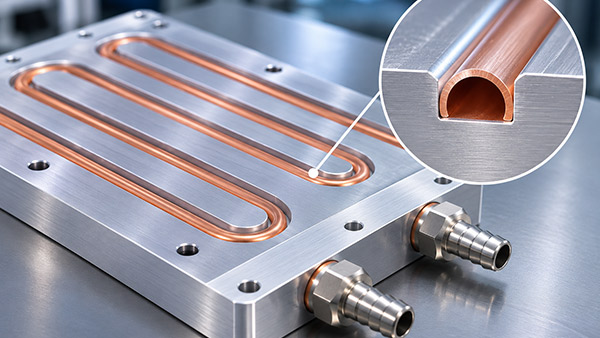
The quality of this interface can influence thermal resistance and production consistency. Even when the tube diameter and coolant flow remain unchanged, variations in groove fit, tube position, or fixing method may affect heat transfer.
For OEM equipment manufacturers, tube-to-base contact should be treated as a controlled manufacturing requirement rather than a purely mechanical assembly detail.
Why Is Tube-to-Base Contact Important?
The thermal path in an embedded tube cold plate includes several interfaces.
Heat first enters the aluminum plate through its mounting surface. It then spreads through the base toward the embedded tube.
At the tube interface, heat must cross from the base into the tube wall before reaching the coolant.
Air gaps, inconsistent contact, or unsuitable interface materials can introduce additional thermal resistance.
As a result, two cooling plates with the same external dimensions may perform differently if their tube-to-base contact conditions are not consistent.
1. Control the Machined Groove Geometry
The groove positions the tube within the aluminum base and helps determine the available contact area.
Important groove characteristics include:
Groove width and depth.
Cross-sectional shape.
Position relative to the heat source.
Dimensional consistency along the route.
Surface condition and burr removal.
A groove that is too large may leave excessive clearance around the tube.
A groove that is too tight may make assembly difficult or cause unwanted tube deformation.
The required dimensions should be established according to the tube specification and selected embedding process.
2. Evaluate Tube Diameter and Dimensional Variation
Metal tubing has manufacturing tolerances for outside diameter and wall thickness.
Additional dimensional changes may occur during bending.
When the tube is assembled into a machined groove, these variations influence fit and retention.
Therefore, the supplier should evaluate the expected tube size range together with the groove tolerance.
3. Select an Appropriate Fixing Method
Different embedded tube designs use different methods to secure tubing inside the base.
Depending on the project, mechanical retention, controlled forming, or suitable thermal interface materials may be considered.
Some constructions may use joining processes, but the correct method depends on the material combination and approved manufacturing requirements.
The fixing method must maintain tube placement without causing unacceptable damage or restricting the coolant passage.
4. Consider Thermal Interface Materials
In some designs, a suitable thermally conductive material may be used to reduce gaps between the tube and surrounding base.
However, the material must be compatible with the expected temperature, assembly method, and required service life.
The presence of a thermal interface material does not automatically guarantee good performance.
Bondline thickness, application consistency, and material properties can all affect the result.
Tube-to-Base Contact Design Checklist
| Parameter | Potential Risk | Recommended Control |
|---|---|---|
| Groove width | Excessive clearance or tube interference | Define fit based on tube tolerance and process |
| Groove depth | Incorrect tube position | Inspect against approved drawing |
| Tube diameter | Variable contact conditions | Control incoming tube specification |
| Bend deformation | Inconsistent groove fit | Evaluate representative formed tubes |
| Fixing method | Movement or unintended deformation | Qualify the assembly process |
| Interface material | Excessive thermal resistance | Control material and application method |
How Can Contact Quality Be Verified?
Directly measuring the internal contact interface after assembly may be difficult.
For this reason, manufacturers often rely on a combination of controlled dimensions, process inspection, and finished-product testing.
Depending on application risk, verification may include:
Measurement of tube and groove dimensions.
Inspection of tube positioning before final fixing.
Verification of the approved embedding process.
Dimensional inspection of the completed plate.
Representative thermal performance testing.
Additional destructive or nondestructive examination where justified.
Leak testing confirms coolant containment, but it does not independently verify the thermal quality of the tube-to-base interface.
Why Production Repeatability Matters
A prototype may achieve acceptable temperatures, but repeated OEM production requires consistent manufacturing conditions.
Changes in tube material, groove machining, forming tools, or fixing methods can influence the contact interface.
Critical process changes should be reviewed according to the customer's change-control requirements.
For higher-volume projects, representative inspections and production records can help identify variations before they affect a large number of assemblies.
What Should Buyers Include in the Drawing?
A complete specification may identify the base material, tube dimensions, groove layout, assembly requirements, heat-source positions, and thermal acceptance conditions.
Buyers should also define whether specific manufacturing records or prototype qualification results are required.
Unnecessary tolerances should be avoided, but functional dimensions must be clearly controlled.
Custom Aluminum Cooling Plate Manufacturing with KINGKA
KINGKA provides custom aluminum cooling plate manufacturing for OEM electronics and industrial thermal management.
Available manufacturing processes include CNC groove machining, metal tube forming, tube embedding, and application-specific finishing and inspection.
For projects where the tube-to-base interface is thermally critical, customers can provide drawings and test criteria for a manufacturing feasibility review.
Develop a Custom Embedded Tube Cooling Plate
Need an aluminum cooling plate with controlled tube positioning and manufacturing requirements? Share your drawings, thermal targets, and production quantities with KINGKA.
Explore KINGKA Tube Liquid Cold PlatesFrequently Asked Questions
Does tighter tube-to-base contact always improve cooling?
Not automatically. Contact quality depends on interface geometry, materials, deformation, and the completed assembly. Excessive interference may damage the tube.
Can thermal adhesive improve an embedded tube cold plate?
A suitable material may reduce interface gaps, but its performance depends on thermal properties, thickness, application, and operating conditions.
Can leak testing confirm tube-to-base thermal contact?
No. Leak testing checks fluid containment. Thermal performance and interface quality require appropriate separate verification.
Should groove tolerances be specified on an aluminum cooling plate drawing?
Yes, when groove geometry affects tube fit, manufacturing feasibility, or thermal performance. The required tolerances should be agreed with the manufacturer.