

Large aluminum cooling plates are often selected for industrial electronic assemblies that contain several heat-generating components. Their wide contact surfaces can accommodate multiple power modules, but achieving reliable dimensional accuracy across a large plate requires careful manufacturing planning.
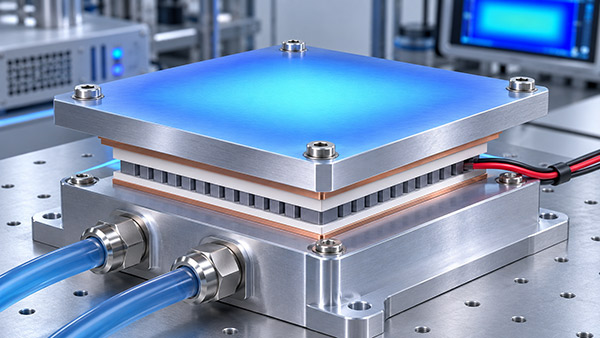
One challenge is warpage during CNC machining. A plate may appear flat while held in a fixture, then bend or twist slightly after the clamping force is released.
For OEM manufacturers, understanding the causes of machining distortion can help reduce rework, assembly problems, and inconsistent thermal contact.
What Is Machining Warpage?
Warpage refers to unwanted changes in a component's shape, such as bowing, twisting, or local distortion.
In an aluminum cooling plate, warpage can affect the overall mounting surface or the relationship between mounting locations.
Not every warped plate has the same problem. Some parts may show global bow, while others have localized height variation near pockets, grooves, or threaded features.
The drawing should distinguish the overall shape requirements from the flatness of critical thermal contact regions.
Why Can Aluminum Plates Distort During Machining?
1. Residual Stress in the Starting Material
Aluminum stock can contain residual stresses from prior manufacturing and heat-treatment operations.
When machining removes material, the internal stress distribution may change, allowing the remaining part to deform.
The amount of distortion depends on the original material condition, removal pattern, geometry, and process.
2. Uneven Material Removal
Removing substantial material from one side of a plate can create an unbalanced remaining structure.
This is particularly relevant when machining deep tube grooves into one surface while keeping the opposite side relatively thin.
3. Excessive Workholding Force
Clamping a thin plate tightly against a fixture may temporarily straighten it.
Once the clamps are released, the plate can return toward its unstressed shape.
Measurements taken only while the component is tightly clamped may therefore hide a dimensional problem.
4. Machining Heat
Cutting operations generate heat. Uneven temperature changes can cause temporary expansion and influence dimensional measurements.
Suitable machining conditions and a defined inspection temperature help reduce uncertainty.
Practical Ways to Control Warpage
Review the Starting Material
Select the specified aluminum alloy and temper with appropriate consideration of material condition and dimensional requirements.
Where necessary, discuss available stock preparation and stress-related manufacturing risks with the supplier.
Plan the Roughing and Finishing Sequence
Instead of attempting to finish every critical surface immediately, manufacturers may use separate rough-machining and finishing stages.
Intermediate measurement and appropriate process allowances can help identify distortion before the final dimensions are produced.
Use Controlled Fixturing
Workholding should support the part without introducing excessive deformation.
Fixture design should reflect the location of thin sections, machined grooves, and functional mounting surfaces.
Maintain Adequate Local Material
Plate thickness, groove depth, and pockets should be evaluated together.
Removing unnecessary material may reduce weight, but it can also decrease stiffness and increase distortion sensitivity.
Inspect the Released Part
For important flatness requirements, inspection should represent the condition specified by the drawing.
Depending on the specification, this may require measuring the component in a defined free-state or supported condition rather than applying strong clamping forces.
Warpage Control During Embedded Tube Assembly
Aluminum cooling plate production does not necessarily end after groove machining.
Metal tubing may be formed, positioned, and fixed within the base. These operations can introduce additional mechanical loads or affect the completed geometry.
Consequently, it may be necessary to inspect both the machined base and the finished tube-embedded assembly.
Any subsequent corrective machining should preserve the required material thickness and clearance from the coolant path.
Manufacturing Control Checklist
| Stage | Main Risk | Recommended Review |
|---|---|---|
| Raw material | Residual stress and initial distortion | Confirm material specification and stock condition |
| Rough machining | Unbalanced material removal | Review machining sequence and remaining stock |
| Workholding | Clamping-induced deformation | Evaluate fixture support and clamping forces |
| Finish machining | Dimensional movement | Check critical contact areas and datums |
| Tube embedding | Assembly-induced distortion | Inspect completed plate geometry |
| Final inspection | Unrepresentative measurement | Use the specified support and measurement method |
Should Every Large Plate Receive Stress Relief?
No. The appropriate treatment depends on the selected material condition, process history, and product requirements.
Additional thermal processing may change the temper, mechanical properties, or condition of an already assembled plate.
It should only be considered through a qualified manufacturing process, not added automatically as a general solution to warpage.
Custom Aluminum Cooling Plate Manufacturing
KINGKA provides custom aluminum cooling plate manufacturing using machined metal bases and embedded cooling tubes for industrial thermal management applications.
OEM customers should provide plate dimensions, critical contact regions, groove geometry, material requirements, and inspection criteria for manufacturing review.
Develop a Custom Aluminum Cooling Plate
Need a large CNC-machined cooling plate with controlled mounting dimensions and embedded tubing? Share your drawings and project requirements with KINGKA.
Explore KINGKA Tube Liquid Cold PlatesFrequently Asked Questions
Why can a cooling plate become warped after CNC machining?
Residual stress redistribution, uneven material removal, workholding effects, and temperature changes can contribute to distortion.
Does thicker aluminum always eliminate warpage?
No. Greater thickness may increase stiffness, but material condition, machining sequence, and geometry remain important.
Should flatness be measured while the part is clamped?
The correct measurement condition depends on the approved drawing. Strong clamping can conceal free-state distortion.
Can tube embedding affect final plate flatness?
Yes. Assembly forces and subsequent manufacturing operations may affect the completed plate geometry.