

An aluminum cold plate with embedded copper tubing offers a practical way to transfer heat from industrial electronic components into circulating coolant. However, the thermal and hydraulic performance of the finished assembly depends partly on how accurately the tubing is formed.
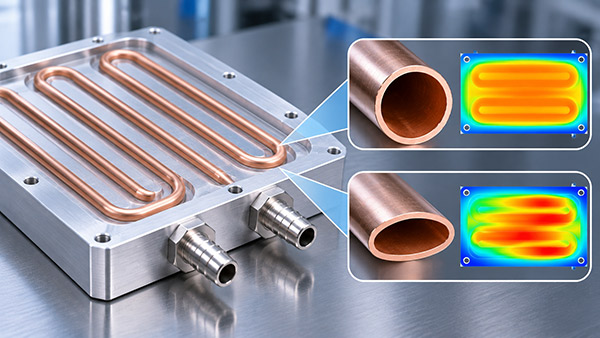
During tube bending, the circular cross-section may become slightly oval. Excessive deformation can restrict the coolant passage, increase pressure loss, and make the tubing more difficult to fit into machined grooves.
For OEM manufacturers, tube bend ovality is an important manufacturing characteristic that should be considered during the design and qualification of custom aluminum cold plates.
What Is Tube Bend Ovality?
Tube bend ovality describes the difference between the major and minor diameters of a tube's cross-section after forming.
When a straight circular tube is bent, the material experiences tension along the outside of the bend and compression along the inside.
Depending on the tube material, wall thickness, bend radius, and bending method, the cross-section may become oval rather than remaining perfectly circular.
A commonly used dimensional expression is:
Ovality (%) = [(Dmax - Dmin) / Dnom] × 100
Where:
Dmax: Maximum measured outside diameter.
Dmin: Minimum measured outside diameter.
Dnom: Nominal tube outside diameter.
The exact calculation and acceptance method should be defined by the applicable tubing or customer specification because different standards may use different conventions.
Why Does Ovality Matter in a Liquid Cold Plate?
1. Coolant Flow Area
Tube deformation changes the geometry of the coolant passage.
Excessive flattening can reduce the available flow area and increase local flow resistance.
The impact depends on the resulting internal geometry and the operating flow rate.
2. Pressure Drop
Changes in cross-sectional shape can affect friction and local pressure losses.
In a cooling loop containing several bends, these effects may contribute to the overall hydraulic resistance.
However, pressure drop should be evaluated for the complete tube path rather than estimated from ovality alone.
3. Tube-to-Groove Fit
Embedded tube cold plates typically use machined grooves to position tubing inside the aluminum base.
If tube deformation varies significantly between bends, it may become difficult to maintain consistent placement and contact with the groove.
4. Tube Wall Integrity
Bending can cause wall thinning on the outside of the bend and compression-related deformation on the inside.
Severe deformation may affect the mechanical integrity of the tube, particularly when the cooling circuit operates under pressure or repeated thermal cycles.
How Bend Radius Influences Tube Deformation
The bend radius determines how sharply the tube changes direction.
A smaller bend radius generally requires greater deformation of the material.
Depending on the geometry, a tight bend may increase the risk of flattening, wrinkling, or wall thinning.
However, there is no single minimum bend radius that applies to every copper tube or metal tubing product.
The appropriate radius depends on:
Tube outside diameter.
Tube wall thickness.
Material grade and temper.
Bending equipment and tooling.
Required dimensional accuracy.
Mechanical and pressure requirements.
Illustrative Tube Ovality Calculation
Consider a hypothetical tube with a nominal outside diameter of 8.0 mm.
After bending, the maximum measured outside diameter is 8.2 mm and the minimum measured diameter is 7.7 mm.
Ovality = [(8.2 - 7.7) / 8.0] × 100
Ovality = 6.25%
This figure describes the measured dimensional change under the stated convention. It does not indicate whether the tube is acceptable.
Acceptance depends on the agreed bending specification, actual pressure requirements, and validated cooling performance.
How to Reduce Tube Bending Defects
Choose an Appropriate Bend Radius
Review the minimum practical radius before finalizing the tube routing.
Use Suitable Bending Tooling
Tooling should be selected according to tube dimensions, material properties, and the intended bend geometry.
Control Material Consistency
Changes in tube material condition or wall thickness can affect the bending response.
Inspect Representative Bends
Initial samples should be evaluated for deformation, alignment, visible defects, and relevant dimensions.
Validate the Completed Cooling Path
Where required, verify flow resistance, pressure integrity, and thermal performance after the tubing is assembled into the cold plate.
Tube Bending Inspection Checklist
| Inspection Item | Purpose |
|---|---|
| Bend radius | Confirm conformity to approved routing geometry. |
| Outside diameter | Evaluate cross-sectional deformation. |
| Ovality | Check maximum and minimum diameters. |
| Wall condition | Identify wrinkling, excessive thinning, or damage. |
| Tube alignment | Confirm fit with the machined base grooves. |
| Pressure integrity | Verify agreed pressure and leak requirements. |
| Flow characteristics | Evaluate hydraulic performance where necessary. |
Custom Aluminum Cold Plate Manufacturing with KINGKA
KINGKA manufactures custom aluminum cold plates with embedded metal tubing for industrial electronics, power equipment, and other liquid cooling applications.
Our manufacturing process can include CNC groove machining, tube bending, embedding, and final inspection according to customer drawings and project specifications.
For OEM buyers, defining tube geometry and relevant inspection criteria early helps reduce manufacturing uncertainty.
Discuss Your Custom Aluminum Cold Plate
Need an embedded tube cold plate with specific tube routing, bend geometry, and pressure requirements? Share your drawings and cooling specifications with KINGKA.
Explore KINGKA Tube Liquid Cold PlatesFrequently Asked Questions
Does every bent tube have some ovality?
Some cross-sectional deformation is common during tube bending. The amount depends on the material, tooling, dimensions, and process conditions.
Does tube ovality always increase cold plate pressure drop?
Not necessarily by a measurable amount. Its impact depends on internal geometry, flow conditions, and the overall coolant path.
Can a tighter tube bend improve cold plate compactness?
A smaller bend radius may allow more compact routing, but it must remain compatible with tube integrity and manufacturing requirements.
Should tube bend inspection be included in an OEM drawing?
For designs where bend deformation affects fit or performance, relevant dimensions and acceptance criteria should be defined in the controlled specification.