As electronic systems continue to deliver higher power in smaller spaces, traditional air cooling is often no longer enough to control operating temperatures effectively. Liquid Cold Plates provide an efficient thermal management solution by transferring heat directly from high-power components into a circulating liquid coolant.
Compared with conventional heat sinks and air cooling systems, a Liquid Cooling Plate can provide higher cooling capacity, better temperature uniformity, compact system integration, and greater design flexibility. These advantages make liquid cold plates widely used in EV batteries, data centers, power electronics, medical equipment, laser systems, and industrial applications.
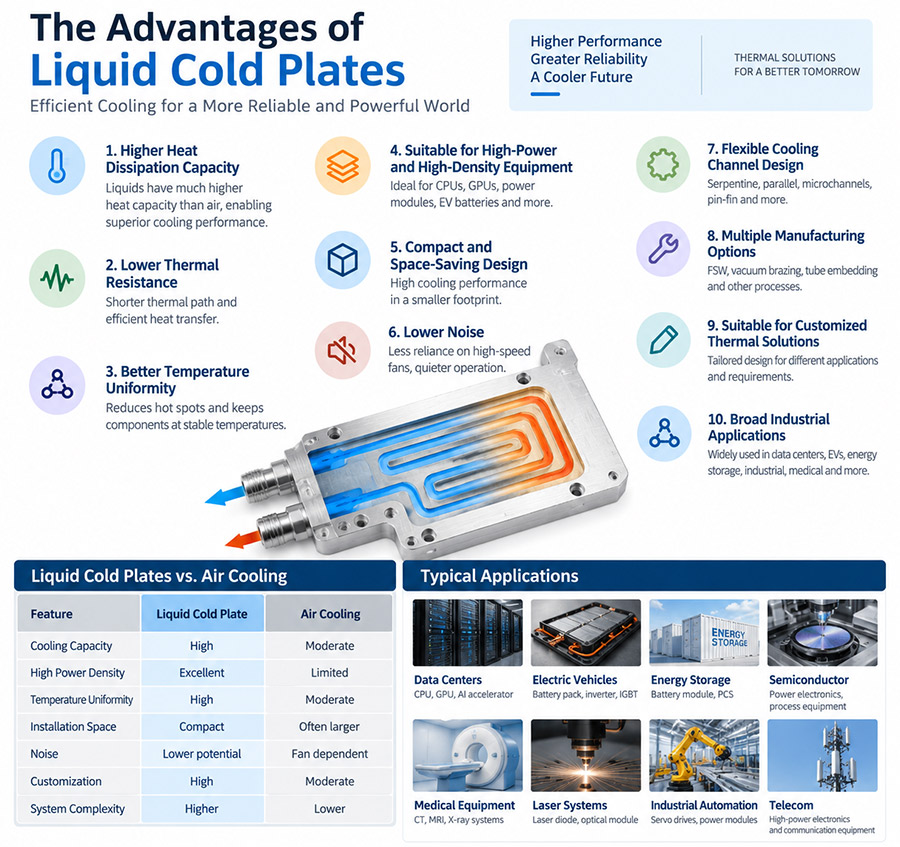
1. Higher Heat Dissipation Capacity
One of the biggest advantages of liquid cold plates is their ability to handle high heat loads.
Liquids such as water or water-glycol mixtures have much higher heat capacity than air. When coolant flows through internal channels inside the cold plate, heat is rapidly transferred away from the heat source.
This allows Cold Plate Cooling Systems to manage components with high power density, including:
For applications where air cooling cannot maintain acceptable operating temperatures, liquid cooling can provide significantly greater thermal performance.
2. Lower Thermal Resistance
A well-designed liquid cold plate creates a short thermal path between the heat-generating component and the coolant.
Heat typically travels through:
Electronic component → Thermal interface material → Cold plate → Coolant
By optimizing the cold plate material, channel layout, surface flatness, and coolant flow, manufacturers can reduce thermal resistance and improve heat transfer efficiency.
Lower thermal resistance helps keep critical electronic components within a stable operating temperature range.
3. Better Temperature Uniformity
Temperature uniformity is especially important for batteries, power electronics, and semiconductor systems.
A properly designed liquid cold plate distributes coolant across the heat source so that heat can be removed more evenly. This helps reduce localized hot spots and temperature differences across the system.
For example, in an EV battery pack, excessive temperature variation between battery cells may negatively affect charging performance, battery life, and system stability.
A customized battery liquid cooling plate can optimize channel routing according to the battery module layout, helping maintain a more consistent temperature across the pack.
4. Suitable for High-Power and High-Density Equipment
Modern electronic equipment is becoming increasingly compact while power density continues to rise.
AI servers, high-performance GPUs, EV power electronics, energy storage systems, and industrial lasers may generate large amounts of heat within a limited installation space.
Liquid cold plates are suitable for these environments because they can remove large amounts of heat without requiring oversized heat sinks or high-speed fans.
This makes liquid cold plate cooling particularly attractive for compact equipment where installation space is limited.
5. Compact and Space-Saving Design
Compared with large air-cooled heat sinks, liquid cold plates can often achieve similar or better thermal performance with a much smaller footprint.
The internal cooling channels are integrated directly into the plate, allowing engineers to design thermal systems around the available mechanical space.
Cold plates can also be manufactured in custom shapes with:
This design flexibility makes them easy to integrate into compact electronic assemblies.
6. Lower Noise
Air cooling systems often rely on fans or blowers to generate sufficient airflow. In high-power systems, larger or faster fans may be required, increasing system noise.
Liquid cold plates can transfer heat efficiently with much less dependence on local airflow.
Although pumps and other liquid cooling components are still required, properly designed liquid cooling systems can significantly reduce fan requirements.
This is particularly useful in applications such as:
Medical equipment
Data centers
Laboratory systems
Industrial electronics
Communication equipment
7. Flexible Cooling Channel Design
Another major advantage of custom liquid cold plates is the ability to optimize internal channels for specific heat sources.
Common channel structures include:
Different channel designs provide different combinations of heat transfer performance, coolant flow rate, and pressure drop.
For example, microchannels can increase the heat transfer surface area for high heat flux applications, while embedded tube designs can provide a simpler and more cost-effective solution for moderate heat loads.
8. Multiple Manufacturing Options
Liquid cold plates can be manufactured using several technologies depending on thermal requirements, pressure requirements, production volume, and cost.
Common manufacturing methods include:
Friction Stir Welding (FSW) is commonly used to seal machined cooling channels in aluminum cold plates.
It provides strong joints without melting the base material and is suitable for high-performance cooling systems.
Vacuum Brazed Liquid Cold Plates
A brazed liquid cold plate can support complex internal structures such as fins, microchannels, and multi-layer cooling passages.
Vacuum brazing is commonly used where high heat transfer efficiency and complex flow structures are required.
Tube Liquid Cold Plates
Copper or stainless-steel tubes can be embedded into aluminum plates to create a reliable coolant path.
These cold plates are often used when customers need a practical balance between cooling performance and manufacturing cost.
9. Suitable for Customized Thermal Solutions
Different electronic systems have different heat loads, installation spaces, coolant requirements, and mechanical interfaces.
For this reason, liquid cold plates are highly suitable for OEM and custom thermal management projects.
A custom liquid cold plate manufacturer can optimize parameters such as:
This makes it possible to develop cooling solutions based on the actual operating conditions of the customer's equipment.
10. Broad Industrial Applications
Because of their high cooling efficiency and flexible design, liquid cold plates are used across many industries.
| Application | Typical Cooling Targets |
|---|
| Data Centers | CPU, GPU, AI accelerator |
| Electric Vehicles | Battery pack, inverter, IGBT |
| Energy Storage | Battery module, PCS |
| Semiconductor | Power electronics, process equipment |
| Medical Equipment | CT, MRI, X-ray systems |
| Laser Systems | Laser diode, optical module |
| Industrial Automation | Servo drives, power modules |
| Telecom | High-power electronics and communication equipment |
As equipment power density continues to increase, liquid cooling is becoming an increasingly important thermal management technology.
Liquid Cold Plates vs. Air Cooling
| Feature | Liquid Cold Plate | Air Cooling |
|---|
| Cooling Capacity | High | Moderate |
| High Power Density | Excellent | Limited |
| Temperature Uniformity | High | Moderate |
| Installation Space | Compact | Often larger |
| Noise | Lower potential | Fan dependent |
| Customization | High | Moderate |
| System Complexity | Higher | Lower |
Air cooling remains suitable for many low- and medium-power systems, while liquid cold plates are generally preferred when thermal loads become too high for conventional airflow-based cooling.